
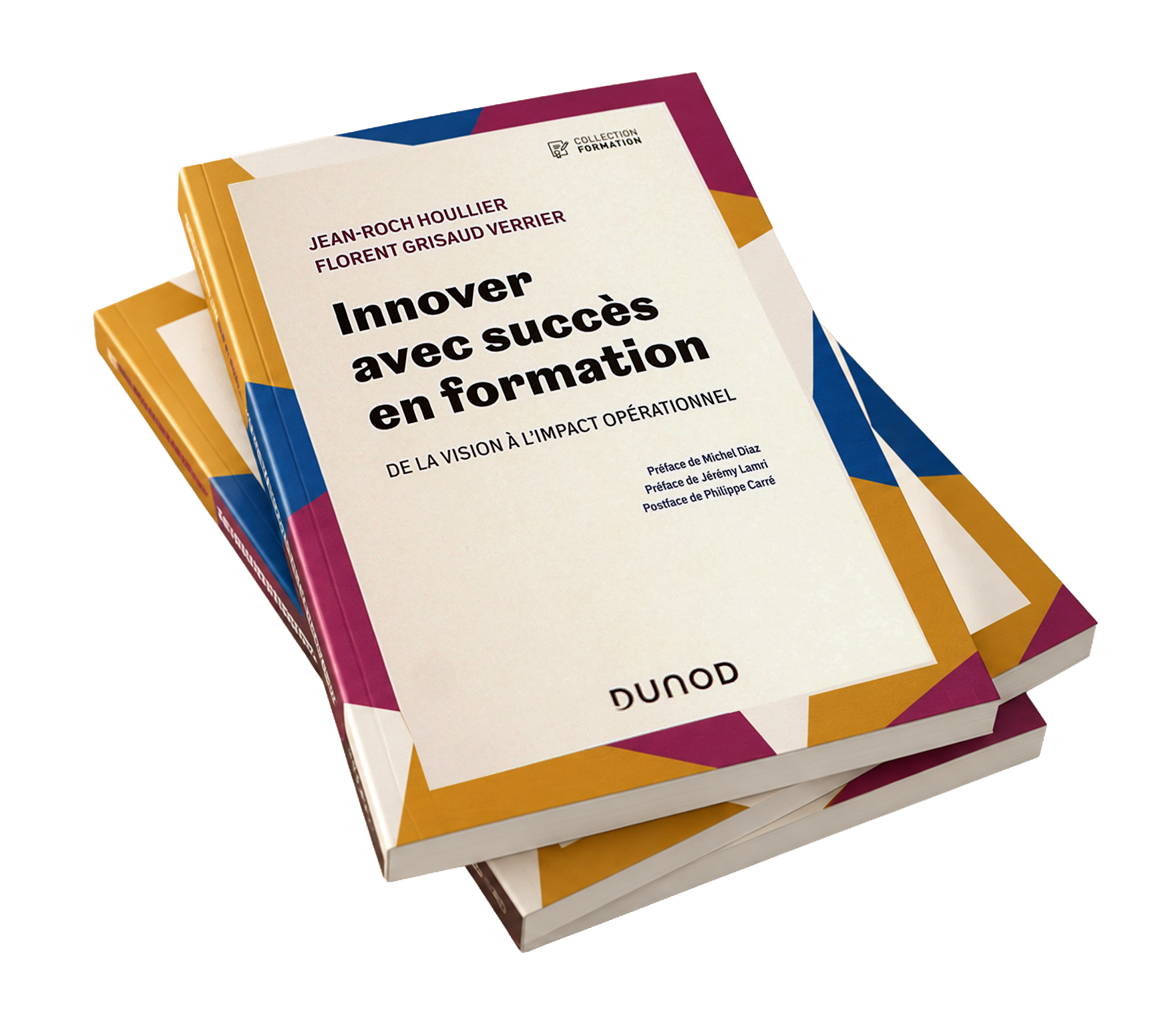
At the event A deep dive into innovation in L&D, organised by Klara at Station F to celebrate the publication of Innover avec succès en formation (Original title in French) by Jean-Roch Houllier and Florent Grisaud Verrier, the same question was asked of every speaker:
In your view, what is innovation in learning?
The answers were different, reflecting the four projects showcased during the evening. Yet they revealed several common themes. Innovation in learning is not defined solely by the technology it uses. Its value comes from responding to a genuine need, being useful to the people concerned and creating a concrete transformation.
The projects Safran × Klara, Medtronic × Pitchboy, SKEMA and L’Oréal × Bealink explored this question through real-life situations, decisions made and lessons from experience. They show that there is no single way to innovate in learning. There are, however, several useful reference points for understanding what makes an approach relevant and sustainable.
What these four projects teach us about innovation
1. It starts with a genuine need
An innovation in learning starts with a situation that needs to be understood, not with a technology looking for a use.
The need may come from operations, Learning teams, line managers or employees themselves. It may concern knowledge transfer, skills development, practice, mobility or support for an organisational transformation.
In the Safran × Klara project, the thinking began with very practical challenges around visibility of skills, authorisations and learning needs. The aim was not to digitise for the sake of digitising. It was to create a clearer connection between available skills and operational needs.
This clarification stage is essential. It helps define the problem to be addressed, the people concerned and the change expected. It also helps avoid a common pitfall: adopting a solution because it is new, without checking whether it genuinely responds to a priority.

2. It is useful to the people who will use it
An innovation only creates value if the people concerned understand its purpose and can integrate it into their everyday work.
Frontline realities must be taken into account from the design stage onwards. Available time, working habits, familiarity with tools and the specific circumstances of each role all directly influence whether a project is adopted.
This applies to every audience. It concerns frontline employees, sales teams, learners, managers and Learning teams.
The Medtronic × Pitchboy project illustrates this approach through practice in sales conversations. Simulation becomes valuable when it allows teams to work on situations that are close to those they encounter in real life. It creates a space to try, adjust and improve before facing those situations in the workplace.
Innovation then becomes a way of bringing learning closer to real work.
3. It connects vision with implementation
Innovation is not limited to an interesting idea. It must be translated into a project, into actual usage and into working practices.
This is one of the central themes of the book Innover avec succès en formation (Original title in French), written by Jean-Roch Houllier and Florent Grisaud Verrier: moving from vision to operational impact.
This continuity requires the organisation to clarify its intention, define its priorities, identify the skills or behaviours to develop and choose the most appropriate learning solutions. Technology then becomes one means among others.
This approach helps maintain consistency between the initial ambition and what is actually put in place. It also prevents innovation from becoming a catalogue of tools or a series of experiments with no clear connection between them.
For Learning teams, the challenge is therefore to build a coherent and clearly structured system that connects organisational needs, learning journeys and people’s capacity to act.

4. It evolves through contact with the frontline
Innovation is rarely built in a single stage. It develops through experimentation, user feedback and adjustments made throughout the project.
The project presented by SKEMA shows the importance of taking a step back. After several experiments involving AI Coaches, the challenge was to better understand usage and learning needs before considering wider deployment.
This approach helps distinguish between what is driven by novelty and what creates genuine value. It also helps identify the conditions required to scale up: priority audiences, uses to be developed, support to be provided and the role of the solution within the learning environment.
Taking time to observe and adjust is not a delay. It is a way of making the project more reliable and preparing it for continuity.
5. It produces observable effects
Innovation cannot be measured only by the interest it generates when it is launched. It is also important to look at what it changes in practice.
The effects may concern visibility of skills, the quality of practice, the ability to support a transformation or employee mobility. They may also result in better decision-making, changes in management practices or stronger alignment between organisational needs and learning journeys.
The L’Oréal × Bealink project illustrates the ambition to make skills a lever for transformation, development and mobility. Skills are no longer simply described in a framework. They can help organisations understand the capabilities they need and guide people’s professional development.
Quantitative data can be useful when assessing these effects, but it is not always sufficient. User feedback, observations in real work situations and conversations with managers all help complete the analysis.
The important point is to connect the results observed with the initial need. Innovation creates value when it makes it possible to respond to that original challenge more effectively.
Innovation is not valuable simply because it is new
The four projects showcased at Station F involved different technologies, methods and contexts. Their value does not come only from what they implemented. It also comes from the questions they sought to answer.
What problem needed to be solved? Who was concerned? Under what conditions? With which uses? And what changed after implementation?
These questions help move beyond a view of innovation centred on the “wow” factor. A technologically advanced solution may offer little value if it does not respond to a clearly identified need. Conversely, a simpler change can have a significant impact when it genuinely transforms a practice.
Innovation in learning can therefore be technological, pedagogical, organisational or methodological. What matters is its ability to make transformation possible and create concrete value for people and organisations.
To find out more
The book Innover avec succès en formation (Original title in French), written by Jean-Roch Houllier and Florent Grisaud Verrier, offers practical guidance, methods and real-life examples to help Learning professionals move from vision to operational impact.
Discover the book